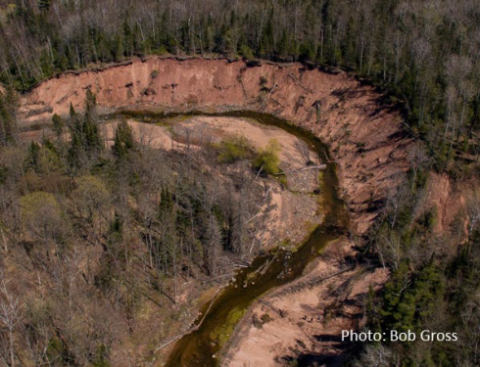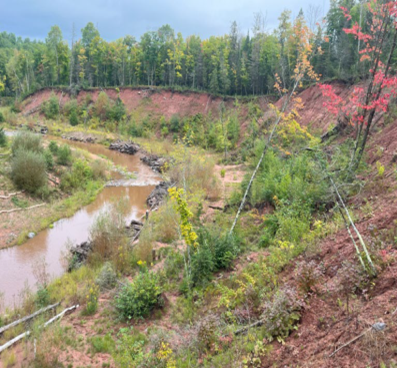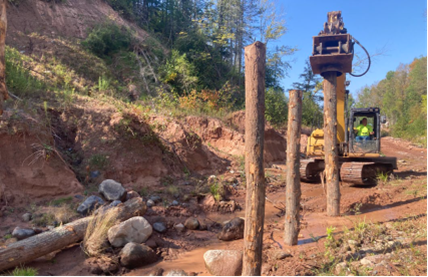
The Chequamegon Bay region of Lake Superior contains many healthy ecosystems and provides abundant recreational opportunities for fishing, hunting, and boating which help support the local economy. However, one of the largest threats to these activities is excessive erosion and sedimentation from streams draining to the lake. Excess sediment covers up habitat for fish and turns crystal clear waters muddy brown. Fish Creek is the largest sediment contributor to Chequamegon Bay.
Beginning in 2018, the GLRI funded a multi-partner project to restore this system for current and future generations by reducing sediment inputs into the lake. The GLRI provided about $1.3 M to enable many partners, including the U.S. Fish and Wildlife Service, Wisconsin Department of Natural Resources, Great Lakes Commission, U.S. Forest Service, Bayfield County Land and Water Conservation Department and the Burke Center, to implement sediment reducing measures such as constructing log structures.
As of September 2025, five sediment reduction and fish habitat projects have restored 5,600 feet of stream channel for fish habitat and reduced approximately 10,600 tons per year of sediment to Fish Creek and Lake Superior. This represents an achievement of 66% of the long-term sediment reduction goal for Fish Creek.
To learn more about this work, watch the recent video created by the Burke Center for Ecosystem Research: Targeted Sediment Reduction to Fish Creek: Keystone Bluff Project